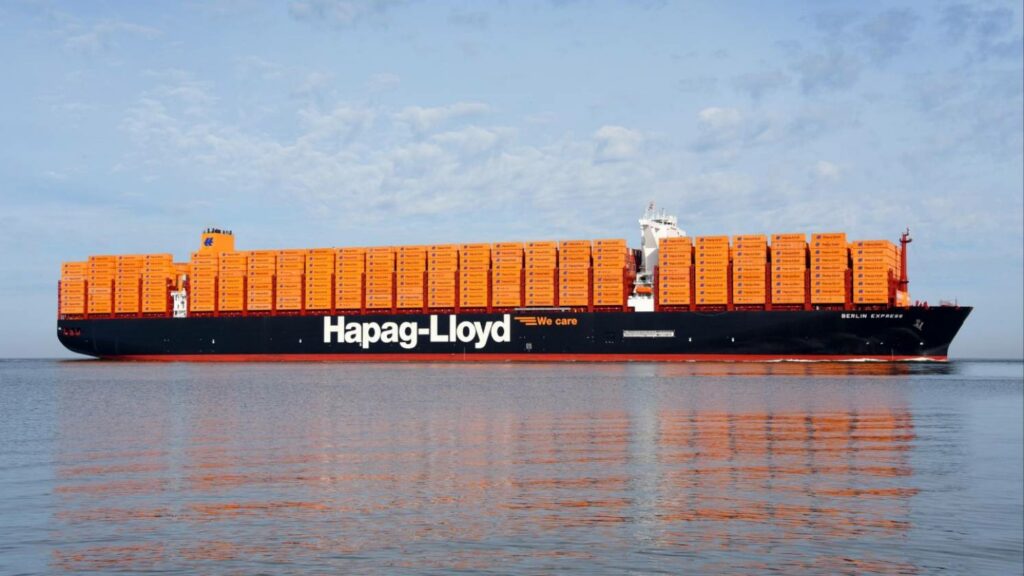
Hapag-Lloyd targets 1.7 million TEU in Africa by 2030
How many boxes does that take when the growth runs inland to Rwanda?
The anniversary release puts a number on Hapag-Lloyd's Africa plan, and this is what that number asks of offices, agents and containers on the ground.
Hapag-Lloyd marks 20 years in South Africa. It wants to move 1.7 million TEU a year in Africa by 2030, up from just over one million in 2026. It is building toward that with its own offices in more countries and reserved terminal space, but has not yet announced the containers and services that growth will need.
Hapag-Lloyd wants to move 1.7 million TEU a year in Africa by 2030. It set the target this week, in a release marking 20 years since it opened its first dedicated office in South Africa. Its African volume passed one million TEU for the first time in 2026. That makes about 70% more cargo in four years.
Compounded, that comes to roughly 14% a year. The whole group grew 8% in 2025.
So far the build-out has been offices and berths. An office in Cotonou, Benin, opened in May. Walvis Bay in Namibia followed on 1 October, along with Kigali, which covers Rwanda and Burundi. In September Hapag-Lloyd signed with DP World for long-term terminal capacity at Dakar, Luanda and Dar es Salaam. The containers that growth will need have not been announced.
The offices lead straight to the boxes. When a market moves to an own office, the carrier takes back the booking, the cargo release and the empty return. The empty return is the cost that grows with the target.
Kigali shows why. Rwanda and Burundi are landlocked, and their cargo moves through Dar es Salaam in Tanzania. A box sent from there to Kigali travels well over 1,000 km by road, and it has to come back.
So how many containers does 1.7 million TEU take? The answer depends on how long each one stays out, as well as on how many TEU are moved. Where the Kigali box can be returned empty decides how long it is out of the pool. It also decides who pays for the empty leg. If the growth leans toward landlocked markets, the number of containers needed grows faster than the volume.
The trade balance adds to that. Most African dry cargo trades are import-heavy, so many of those boxes then leave the continent empty.
Nothing in the release is out of order. People come first, then berths. The equipment is the expensive half, and it is still to come.
The number to watch is Hapag-Lloyd's Africa volume for 2027. On a straight path to 1.7 million, it needs to be around 1.15 million TEU. A figure well short of that would push most of the growth into 2029 and 2030.