World Shipping Council asks the IMO to cap batteries per container
The Invisible Fire Risk: Why Thousands of Laptop Batteries Travel Undeclared
What the proposal actually asks for, why carrier screening systems cannot catch this cargo, and the first date any fix can bind.
Container lines want the IMO to cap how many small lithium batteries can go in one container before the shipper must declare them. Right now that cargo is legal, truthful and invisible, so planners stow it as ordinary freight. Even if governments agree, the rule cannot become mandatory until 2030.
The World Shipping Council, the trade body for the main container lines, has asked the IMO to set a ceiling on how many small lithium-ion batteries can travel in one container before anybody has to say so. There is no ceiling today. By the council's own arithmetic, a box holding around 4,200 laptops carries roughly 416 kWh of stored energy. That is three or four electric cars' worth, and it moves with no dangerous goods declaration and no placard on the door.
The proposal went to the IMO's Sub-Committee on Carriage of Cargoes and Containers, which sat in London from 14 to 18 September. Five governments put their names to it: Germany, the Marshall Islands, the Netherlands, Singapore and Thailand, with a group of industry bodies alongside.
The provision at issue is Special Provision 188 of the International Maritime Dangerous Goods Code. It exempts small cells and batteries from most dangerous goods requirements if they pass the prescribed tests and stay under the size limits, 20 Wh for a cell and 100 Wh for a battery. It says nothing about how many of them may be packed into a single container.
A booking that says laptops, and means laptops
Almost every container fire story of the past eight years has turned on misdeclaration, and carrier spending has followed it there. Every major line now screens booking data against keyword and pattern libraries, hunting for the shipment that says "resin" and means something else. The screening volumes involved run into millions of bookings a month Hazcheck Detect reports roughly 15 million screening requests monthly and 40 to 50 high-risk containers stopped per week.
A shipment under Special Provision 188 walks through all of it by telling the truth. The shipping instruction says laptops. It is laptops. Every validation rule in the booking system passes, and passes correctly, because nothing about the declaration is wrong.
A carrier's dangerous goods systems only see cargo that arrives through a dangerous goods declaration. There is no field on a standard booking for the total watt-hours inside the container, because no rule has ever asked for one. The number exists with the packer and nowhere else. That is the gap, and it is a gap in the rulebook rather than in anyone's software.
The X-Press Godavari, stowed as general cargo
A stowage planner works from the same data, which is to say from nothing.
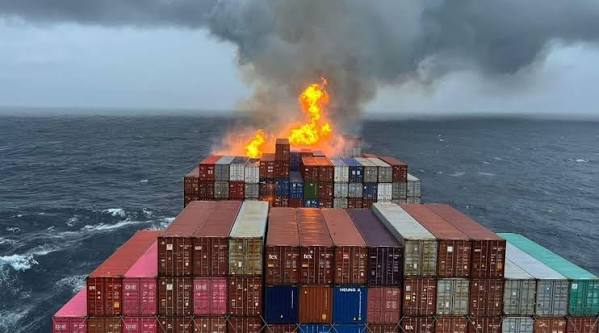
In September 2020 a 40-foot container of battery-powered flashlights caught fire aboard the X-Press Godavari, a Malta-flagged container vessel, off India. The box held more than 7,000 kg of lithium-ion cells. It was fully compliant. It shipped under Special Provision 188 and was therefore undeclared. The packages carried the lithium battery mark. The container did not, because the provision does not require it.
So the planner treated it as general cargo, which on paper is exactly what it was. It went on deck at the outer edge of the stow. Air temperature on the voyage ran 27 to 30 degrees. The cargo's own safety data sheet asked for 20 to 30 degrees and no prolonged direct sunlight. The investigation found the crew did not know what was in the container. Around 90 minutes passed before the response matched the hazard.
That is the operational case in one box. A declared consignment gets a stowage position chosen for it. It gets segregation from what it should not sit beside, an emergency response schedule the crew can act on, and a line in the fire plan. An undeclared one gets whatever the stowage optimiser hands it, which on a well-loaded ship is frequently an outboard tier in the sun.
The gap to 1 January 2030
Only a rule can create the field that would keep that box off that tier. Unusually for a lobbying submission, this one asks for information rather than a prohibition. Nobody is proposing to stop shipping laptops.
The shape of the threshold decides whether it works. A packer has to be able to compute it at the point of packing, which argues for gross mass over aggregate watt-hours. The code already has that shape for nickel-metal hydride batteries, where 100 kg gross in a transport unit triggers documentation with SP963. Consolidated and part-load cargo is the harder case, because no single shipper knows the container total. The sea threshold also has to line up with the UN model regulations, or the same pallet becomes declarable at the quay and not on the truck that delivered it. The council has tabled the question at the UN experts' committee as well as at the IMO, which suggests it knows that.
The submission is explicit about its target: amendment 44-28 of the dangerous goods code, which becomes mandatory on 1 January 2030. Amendment 43-26 was adopted in May this year and takes effect in 2028. It does not carry this.
So even on the fastest realistic path, four more peak seasons run under the present rule, with battery volumes still climbing. Container ship fires are already breaking out somewhere about every 17 days on Allianz figures. Fire frequency across the Container Ship Safety Forum membership has risen three years running, the 2025 performance data reportedly shows frequency more than doubling year on year.
That leaves the commercial lever, and it is the only one carriers hold outright. A line does not need an IMO amendment to write a battery quantity question into its own booking conditions and decline the cargo that will not answer. The Cargo Incident Notification System, the carriers' incident-sharing body, published recommendations on 26 August asking for exactly that kind of transparency on these shipments, so that risk assessment and stowage planning have something to work from. They are recommendations, and they bind nobody.
Three things are worth watching. The first is whether the sub-committee report shows this taken up as an urgent item with a deadline attached rather than simply noted. The second is whether the threshold that emerges is written in kilograms or in watt-hours, because that decides whether a packer in Shenzhen can apply it without a calculation nobody will do. The third is whether a major carrier writes the cap into its own booking terms before 2030. That last one would tell you more than the other two.
Primary sources
- officialBatteries, SP188 exemptions in containerized transport (regulatory filing) World Shipping Council, 2026-09-09
- officialWSC calls on governments to close battery cargo safety gap World Shipping Council, 2026-09-15
- Safety alert: lithium battery fire on board MV X-Press Godavari, investigation report ICHCA International, 2026-09-15
- CINS recommendations on SP188 lithium-ion batteries UK P&I Club, 2026-08-26