Uruguay's Buquebus puts world's largest battery ferry in service
If she arrives late, the master can sail on time with less charge, or sail late.
The charging set-up at both terminals, the turnaround it dictates, and why that condition decides where the next large battery ship can go.
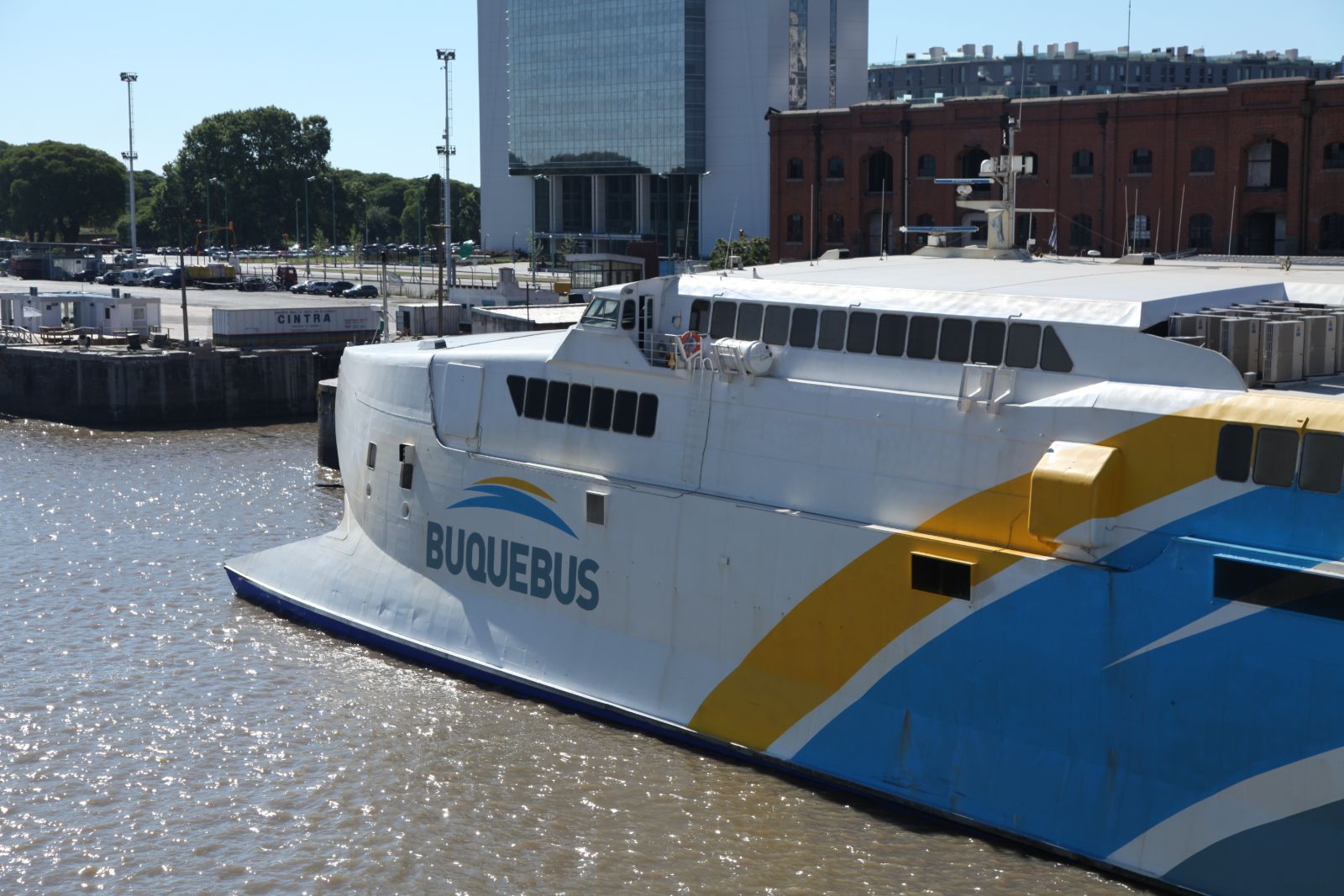
Uruguay's Buquebus has put the world's largest battery-electric ship into service between Buenos Aires and Colonia. The ship recharges at both terminals on every turnaround, so the time at the berth and the power line ashore now do the job of the fuel tank. That works on a short, fixed shuttle with its own quays, and the full timetable is the test.
Buquebus, the Uruguayan ferry operator, has put the world's largest battery-electric ship into service on the River Plate. China Zorrilla is a catamaran built by Incat in Tasmania. She runs the 55 km crossing between Buenos Aires and Colonia del Sacramento in Uruguay on more than 40 MWh of batteries. She recharges at both terminals on every turnaround, so the time at the berth and the power line ashore now do the job of the bunker call.
The power available at the quay decides how long a charge takes. During trials in Hobart, Tasmania, the yard had about two megawatts available, and charging took nearly a week. In Colonia the charge runs from 20 to 80 percent in about 45 minutes. It was the same hull with the same battery.
That speed had to be built ashore. Sixty percent of the battery is about 24 MWh. Moving that in 45 minutes takes a little over 30 MW at the plug. UTE, Uruguay's state power company, built a dedicated line to the port in Colonia. The distributor Edesur built the supply in Buenos Aires.
With the power in place, the limit is the clock. On a diesel ferry the turnaround is about cars and passengers, and fuel goes aboard when the bunker schedule says so. On China Zorrilla the charge must fit inside the time it takes to land and load 225 cars and up to 2,100 people. If she arrives late, the master has two options. He can sail on time with less energy aboard, or sail late with the planned charge.
He cannot win much of that time back. The chargers cannot deliver faster than their rating. Extra speed does not help much either, because speed costs energy the ship needs to arrive with. On a shuttle making several crossings a day, a late sailing carries into every turnaround after it.
The charger also decides where she can call. A diesel ferry that cannot take its berth in Colonia has other places to go. China Zorrilla needs a charger big enough at the far end, and there are two.
On this route it is a sound choice. The route is a short, fixed shuttle with the same two berths every time, and power has been built to each quay. Seen from the container side, this is a shuttle with its own quays, and the ship is the easier half of it.
The timetable is the test. In March, Baird Maritime reported a plan for six crossings a day. Argentine coverage of the launch spoke of daily services, with frequencies to rise gradually. Six a day, each with a charge inside the turnaround, is the number to check the published timetable against.
Primary sources
- officialBuquebus, Banco Santander and IFC sign financing for the world's largest electric ferry on the Argentina-Uruguay route International Finance Corporation, 2024-07-26